
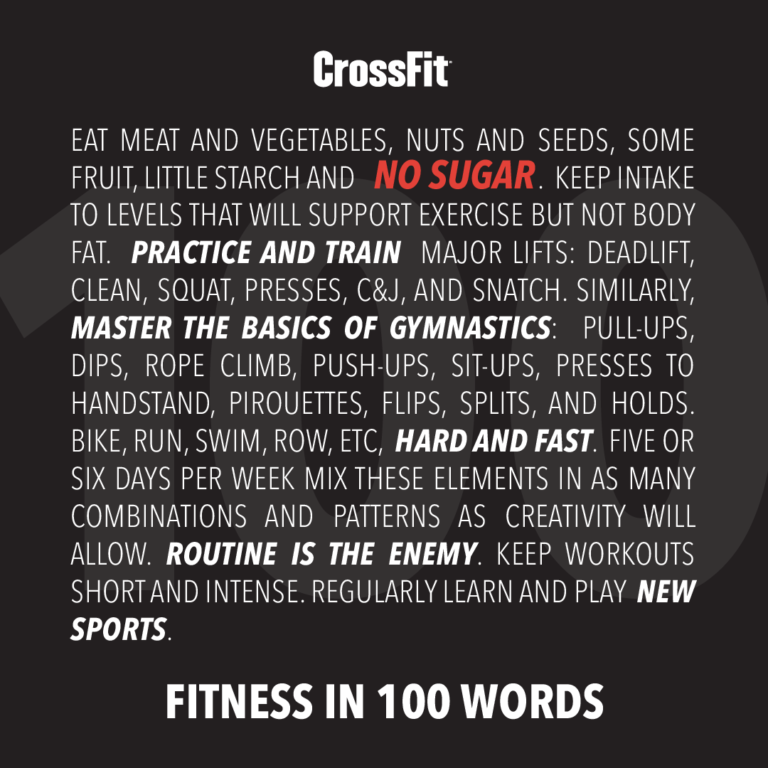
"Eat meat and vegetables, nuts and seeds, some fruit, little starch, and no added sugar." That is the first part of CrossFit's nutrition prescription, and it focuses on the quality of your food.
"Keep intake to levels that support exercise but not body fat." That is the second part of the prescription, and it focuses on the quantity of your food.
These two simple statements are some of the most important principles you can follow if your goal is to improve your health, body composition, and performance in the gym. While many people are drawn to CrossFit because of the workouts, CrossFit is not just a fitness program. It is also a nutrition program. In fact, nutrition is the foundation that supports everything we do inside the gym.
At our gym, we often tell people that if all you do is work out but never focus on your nutrition, then you are not truly doing CrossFit. The workouts are only one piece of the puzzle. To get the most out of the program, you must put just as much attention and focus into your nutrition as you do your training.
Why Quality of Food Matters
The first step is focusing on food quality. CrossFit encourages eating whole, minimally processed foods such as meat, vegetables, nuts, seeds, fruit, and healthy fats. These foods provide the nutrients your body needs to function at its best.
When you consistently eat high-quality foods, several positive things happen:
- Health markers often improve.
- Hormones such as insulin and glucagon become better regulated.
- Energy levels become more stable throughout the day.
- Recovery from workouts improves.
- The risk factors associated with many chronic diseases can decrease.
Beyond health benefits, food quality has a direct impact on body composition and athletic performance. The food you eat provides the building blocks for muscle growth, recovery, and energy production. If your diet is built around processed foods, added sugars, and nutrient-poor choices, it becomes much harder to perform well and achieve the physique you want.
Think of nutrition as fuel. Just like you would not put low-quality fuel into a high-performance race car, you should not expect your body to perform at its highest level when fueled with low-quality food.
Why Quantity Matters
Once food quality is in place, quantity becomes the next important consideration.
You can eat healthy foods and still consume more energy than your body needs. Likewise, you can under-eat and fail to provide enough fuel to support your training and recovery.
CrossFit's recommendation is simple: eat enough to support exercise but not so much that excess energy is stored as body fat.
Finding the right quantity helps optimize body composition by supporting lean muscle mass while managing body fat levels. It also helps ensure you have the energy necessary to train hard, recover properly, and continue making progress over time.
Many people focus on quantity first because tracking numbers feels easier. However, if your food quality is poor, tracking every calorie or macro is often missing the bigger picture.
Start with Quality Before Tracking
One of the biggest mistakes people make is worrying about the details before mastering the fundamentals.
If you are still struggling to eat whole foods consistently, do not worry about tracking every gram of food just yet. Focus on improving the quality of your meals first.
Build habits around:
- Eating lean proteins.
- Filling your plate with vegetables.
- Choosing fruit over sugary snacks.
- Limiting highly processed foods.
- Avoiding added sugars whenever possible.
Once these habits are established, then it makes sense to look at quantity and determine whether adjustments are needed.
Different Approaches to Managing Quantity
There are many nutritional approaches that can help people manage food quantity and achieve their goals.
Some common methods include:
- Intermittent fasting
- Keto
- Macro counting
- Paleo
- Zone Diet
Each of these approaches can work when applied consistently. The best diet is often the one that helps you maintain healthy habits long term.
Within CrossFit, we often recommend starting with the Zone Diet if someone does not know where to begin.
The Zone Diet was developed by Dr. Barry Sears and focuses on balancing meals with specific proportions of protein, carbohydrates, and fat. Meals are divided into "blocks" that help create portion control and balanced nutrition without requiring complicated calculations. The goal is to provide enough energy to support activity while helping regulate blood sugar and hunger levels throughout the day.
The Zone Diet also aligns well with CrossFit's emphasis on eating quality foods while controlling quantity. For many people, it serves as an excellent educational tool to learn what appropriate portion sizes look like.
Don't Major in the Minors
One of the biggest distractions in the nutrition world is the constant focus on small details.
People often become obsessed with questions like:
- What supplements should I take?
- When should I eat?
- Do I need BCAAs?
- Which pre-workout is best?
- Should I take creatine?
While some of these topics may have value in certain situations, they are not where most people should spend their time and energy.
The truth is that the overwhelming majority of your results will come from consistently eating real food and eating the right amount of it.
When you prioritize whole foods and appropriate portions, you naturally obtain the protein, carbohydrates, fats, vitamins, minerals, and other nutrients your body needs to perform and recover.
Of course, there are exceptions. If your doctor or healthcare provider has identified a specific deficiency or medical condition that requires supplementation, that is a different conversation. In those cases, supplements can play an important role. But for most people, supplements should supplement a solid nutrition foundation, not replace it.
The Bottom Line
Nutrition is one of the most powerful tools available for improving health, body composition, and gym performance. CrossFit's nutrition prescription is intentionally simple: focus on the quality of your food first, then focus on the quantity.
Eat real food. Eat mostly whole foods. Eat enough to support your training but not so much that it negatively impacts your body composition.
Master those fundamentals before worrying about supplements, nutrient timing, or the latest nutrition trend.
If you want to get the most out of CrossFit, your nutrition deserves the same commitment and attention as your workouts. When quality and quantity work together, the results inside and outside the gym become much easier to achieve.


