
In CrossFit, few words get misunderstood as often as the word intensity. For many people, intensity sounds like chaos: screaming athletes, bloody hands, people rolling on the floor, loud grunts, sweat pouring everywhere, and heart rates through the roof. Those things might happen in a workout, but none of them define high intensity. They are correlates, not causes. They may show up during a tough workout, but they do not explain what intensity actually is.
When CrossFit talks about high intensity, we are not talking about emotion, volume, or theatrics. We are talking about something far more objective, far more important, and far more measurable.
We are talking about power.
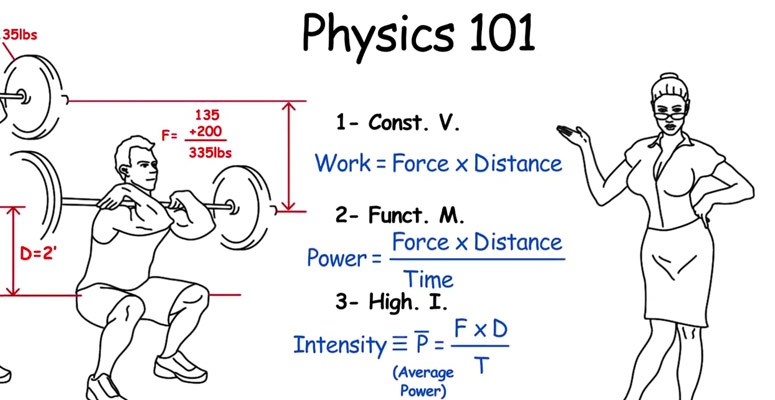
Intensity = Power (Straight From Physics)
High intensity in CrossFit is not a made up idea. It comes directly from physics, where power is a measurable force defined by a simple equation:
Power = Work ÷ Time
Work refers to the amount of force moved over a certain distance. When you divide that by how long it takes, you get power. And that is exactly what CrossFit uses to define intensity.
This is what makes CrossFit special. We are not guessing whether you were intense in a workout. We can see it. We can measure it.
- How long did it take you to finish the workout?
- How many rounds or reps did you complete?
- How much weight did you move on a heavy day?
- How quickly did you move a load from A to B?
All of these represent measurable power output. The higher your power output, the higher your intensity. This approach removes the guesswork and the noise. You do not get fitter because you screamed or sweated. You get fitter because you produced work quickly.
Why the Correlation Mistakes Matter
It is easy to get confused. Heart rate spikes? Must be intense. Sweating a ton? Must be intense. Hands ripped? Definitely intense.
But here is the truth:
- You can get scared and your heart rate will jump.
- You can drink a strong coffee and your heart rate skyrockets.
- You can sweat buckets just standing outside on a hot day.
None of these make you fitter.
They are correlates, things that might happen when you are working hard, but they do not create fitness by themselves. Fitness comes from increasing power output, session after session, week after week.
Intensity Is Always Relative
One of the biggest misconceptions in CrossFit is thinking that high intensity means going all out every single day. That is not what we mean, and that is definitely not what your coaches want.
Intensity is relative to the individual, their physical capacity, their psychological tolerance, and their level of experience. What is intense for one athlete may be moderate for another, and that is okay.
CrossFit is for everyone because intensity can be scaled for everyone.
- New athlete? We scale to a level you can safely sustain.
- Coming off an injury? We adjust to what your body can tolerate.
- Been training for years? We push closer to your threshold.
When we say high intensity, we are not saying maximal intensity. Maximal intensity every day is a fast track to burnout, injury, or frustration. Sustainable intensity, the right level of effort for that athlete on that day, is what creates long term growth.
CrossFit meets you where you are. Scaling is not a downgrade. It is how we deliver the right dose of intensity for each athlete, every day.
Intensity Drives Results
Greg Glassman said it clearly:
Intensity is the independent variable most commonly associated with maximizing the rate of return on favorable adaptations.
What does that mean in plain language?
Intensity delivers results.
If you want to get stronger, leaner, faster, and more conditioned, you need intensity. Not perfection. Not heroics. Not drama. Just focused, consistent, measurable effort.
But, and this is crucial, you should move with intensity only after you can move well.
Mechanics and Intensity Go Hand in Hand
CrossFit is not asking you to choose between good form and fast movement. The two are not in conflict. They are meant to coexist.
We want you to move fast and well.
Good mechanics allow you to safely express intensity. And the more your mechanics improve, the more intensity you can handle. Done properly, intensity actually improves your mechanics because you practice moving efficiently again and again.
This is why your coaches harp on technique. It is not to slow you down. It is so you can safely speed up.
The Bottom Line
High intensity is the engine that drives results in CrossFit. It is not loudness, sweat, or heart rate. It is not suffering for the sake of suffering. It is not chaos.
High intensity is power output, measured through time, reps, loads, and movement. It is objective, it is scalable, and it is unique to you.
When you move well and move with the right level of intensity for your abilities, you unlock the fastest and safest path to better fitness.
At CrossFit Be Someone, our job is simple:
Help you move better.
Help you move safely.
And help you move with the right intensity that delivers the results you are after.
Move well. Move fast. Move with purpose. That is intensity. That is CrossFit.


